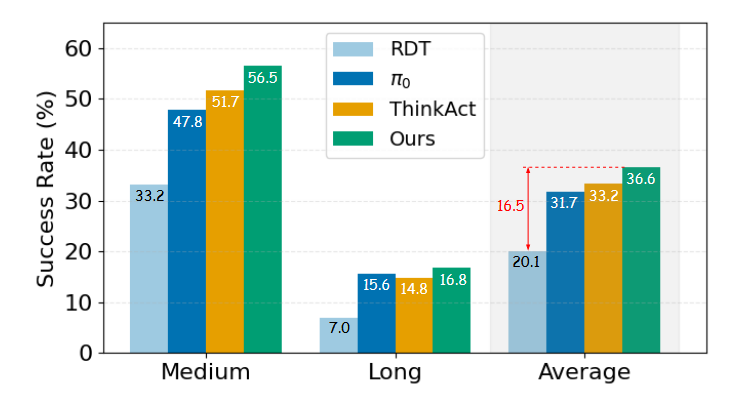
Fast Thinkact
Published:
2026_03_02 Report
1. Previous Work
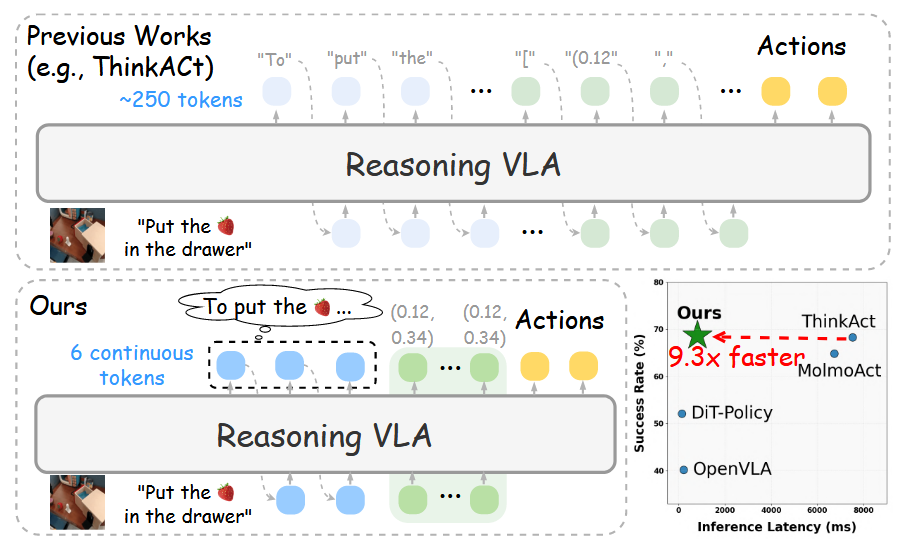
- leverage large-scale robot demonstrations:have limitations in generalization
- incorporating intermediate thinking processes(explicit CoT):suffer from high inference latency due to lengthy reasoning traces
- reasoning dropout:risks performance degradation due to critical information loss
2. Fast-ThinkAct
2.1. Verbalizable Latent CoT by Reward Preferences
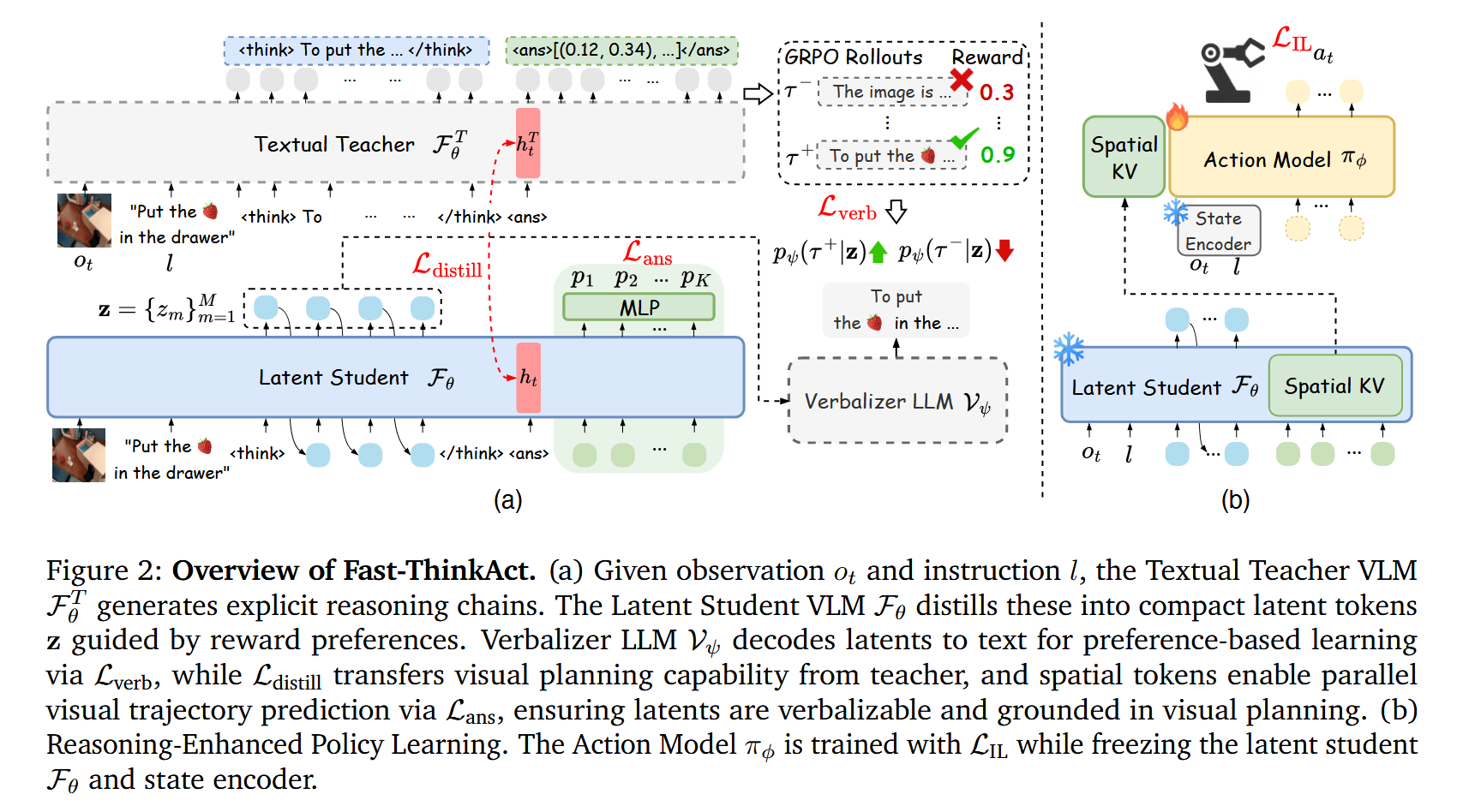
\[\mathcal{J}_{\mathrm{GRPO}}(\theta)=\mathbb{E}_{\tau\thicksim\mathcal{F}_\theta^T}\left[\min\left(r_\theta(\tau)A(\tau),\mathrm{clip}(r_\theta(\tau),1-\epsilon,1+\epsilon)A(\tau)\right)\right]\]where
\(A(\tau)=\frac{R_\tau-\mathrm{mean}(\{R_i\}_{i\in G(\tau)})}{\mathrm{std}(\{R_i\}_{i\in G(\tau)})}\):normalization in the group,relative quality
\(r_{\theta}(\tau) = \frac{\mathcal{F}_{\theta}^{T}(\tau)}{\mathcal{F}_{old}^{T}(\tau)}\):Represents the difference between the new distribution and the old distribution
clip:avoid “one-hot” or overfitting.
where
- \[\tau^+=\arg\max\limits_{\tau\in G}A(\tau)\mathrm{~and~}\tau^-=\arg\min\limits_{\tau\in G}A(\tau)\]
- \(\log\frac{p_{\psi}}{p_{ref}}\):not a preference that arises inherently from \(\tau\) itself.
2.2. Action-Aligned Visual Plan Distillation
\[\mathcal{L}_{\mathrm{distill}}=\|h_t^T-h_t\|_2^2\]where \(h_{t}^{T}\) and \(h_{t}\) are the hidden states from teacher (corresponding to \(\tau^{+}\)) and student, respectively.
hidden state alignment \(\mathcal{L}_{\mathrm{ans}}=\sum_{i=1}^K\|p_i-\hat{p}_i\|_2^2,\mathrm{~with~}p_i=\mathrm{MLP}(h^{\prime}(\mathbf{s}_i))\) output trajectory alignment
2.3. Reasoning-Enhanced Policy Learning
\[\mathcal{L}_{\mathrm{IL}}(\phi)=\ell\left(\pi_\phi(o_t,l,c_t),\hat{a}_t\right)\]where
- \(c_{t}\):which is also \(\{\mathbf{s}_{i}\}\), is in Spatial KV
\(\hat{a}_{t}\)$:ground-truth actions
- \(\ell\):diffusion policy
3. Training Datasets and Evaluation Benchmarks
datasets
- reasoning VLM training
- single-arm visual trajectories
- dual-arm visual trajectories from the AIST dataset
- QA tasks
- reasoning-enhanced policy learning
- OXE dataset
- static Aloha dataset
- reasoning VLM training
benchmarks
- embodied reasoning
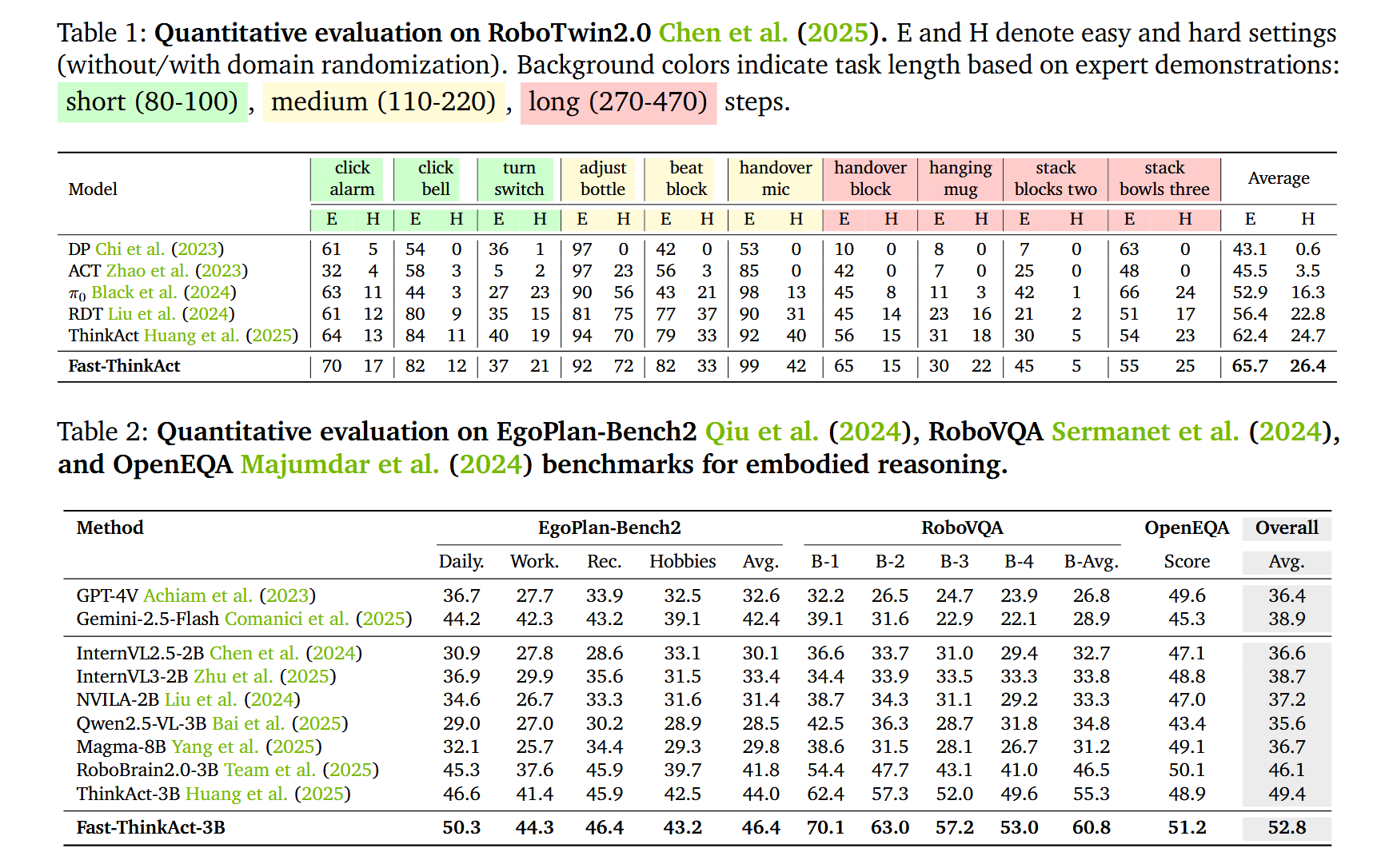
Benchmark Task Metric EgoPlan-Bench2 Multiple-choice question answering accuracy RoboVQA Video-based question answering BLEU score OpenEQA Visual question answering LLM-based scoring RoboFAC Visual question answering LLM-based scoring - robot manipulation
Benchmark Task Key Features SimplerEnv Simulated manipulation tasks Highly correlated with real-world performance LIBERO Diverse manipulation tasks including long-horizon tasks Tests long-horizon planning ability RoboTwin2.0 Complex bimanual manipulation High-difficulty dual-arm tasks
4. Results
- enables long-horizon planning
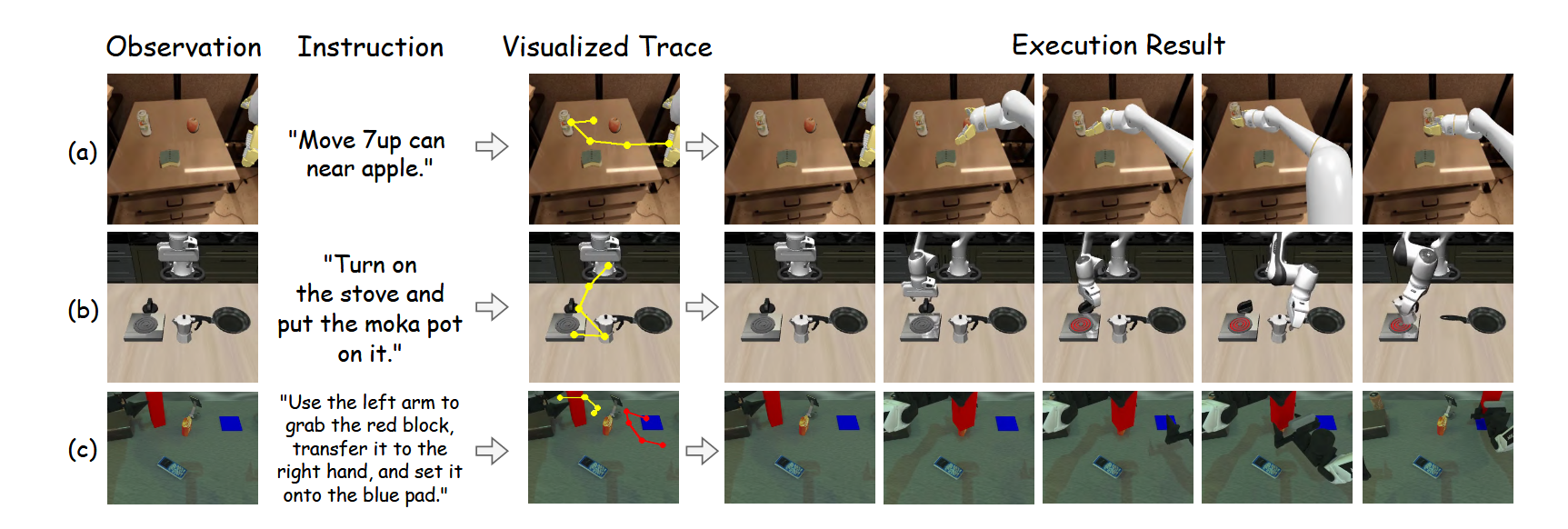
- enables failure recovery
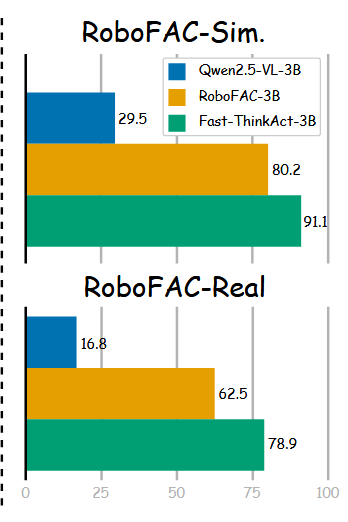
- enables few-shot adaptation